The Digital Schizoid: 25 Years of Gorillaz and the Birth of the Post-Genre Era
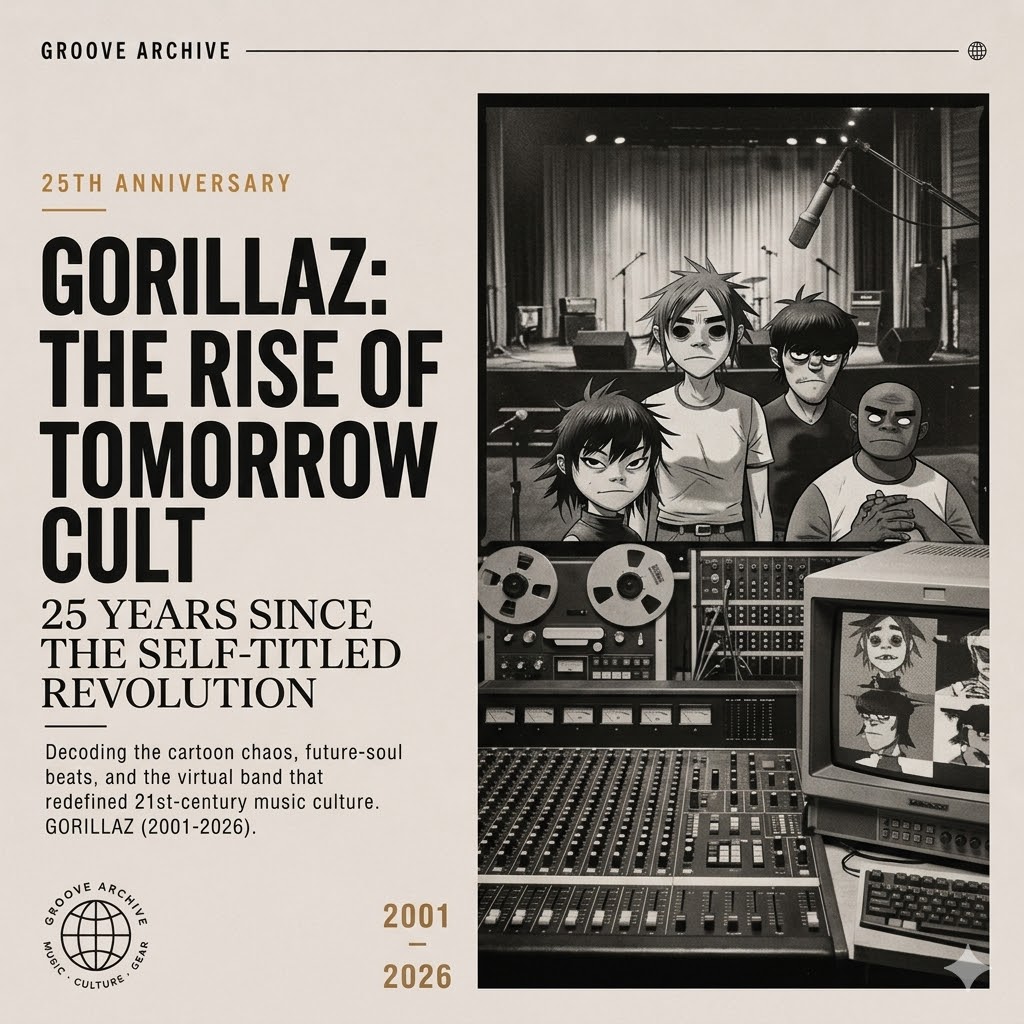
As we reach the third milestone in our anniversary series, we move from the analog heartbreak of Camden and the futuristic laboratories of the mid-2000s to the project Gorillaz that, in 2001, felt like a glitch in the matrix.
Twenty-five years ago, the “virtual band” was a punchline; today, it is the blueprint.
In March 2001, the music world was reeling from the hangover of the boy-band boom and the fading embers of Britpop. Then came a flash of neon, a skeletal grin, and a beat that seemed to belong to every continent and none of them at once. When Damon Albarn and Jamie Hewlett unveiled Gorillaz, it was dismissed by many as a high-concept gimmick—a “cartoon band” to mask an identity crisis. Twenty-five years later, in 2026, we recognize it as the most prophetic debut of the 21st century.
This wasn’t just an album; it was the demolition of the genre wall. By blending dub, hip-hop, lo-fi rock, and Latin influences into a cohesive, post-modern narrative, Gorillaz created the “playlist” era years before the first iPod was even a household name.
The brilliance of the self-titled debut lies in its curated chaos. Produced by Dan the Automator, the record feels like a subterranean radio station broadcasting from a haunted bunker. It is an album that thrives on the tension between Albarn’s melancholic Britpop melodies and the gritty, street-level production of the San Francisco underground.
The Post-Modern Avatar and Cultural Critique
At its core, Gorillaz was a response to the vapidity of MTV culture. Hewlett’s visual world—populated by 2-D, Murdoc, Noodle, and Russel—allowed Albarn to disappear, giving him the freedom to experiment with sounds that would have been “off-brand” for Blur. The album is thick with cultural references: the spaghetti-western whistle and Ennio Morricone-esque melodrama of “Clint Eastwood,” and the frantic, Romero-inspired zombie-horror energy of “M1 A1.” It wasn’t just music; it was a multi-media critique of celebrity, delivered via 12-inch vinyl and Flash-animated music videos.
A Global Dub Odyssey
Groundbreaking genres aren’t born in a vacuum; they are forged through collision. On this record, we hear the spiritual weight of Buena Vista Social Club’s Ibrahim Ferrer on “Latin Simone,” colliding with the high-octane hip-hop delivery of Del the Funky Homosapien. For the audiophile, the track “Tomorrow Comes Today” remains a masterclass in trip-hop atmosphere. The way the harmonica—a traditional blues instrument—is distorted into a ghostly, digital sigh over a heavy dub bassline was revolutionary. It proved that “Global” music didn’t have to be polite; it could be dark, heavy, and incredibly cool.
The Blueprint for the 21st Century
Looking back from 2026, the influence of this debut is staggering. It birthed a new kind of “Electronic-Indie-Hop” that has become the default setting for modern pop. The album’s refusal to stay in one lane gave permission to an entire generation of bedroom producers to mix genres without apology. It was the first time a major rock star successfully transitioned into a curator, proving that the identity of the “band” mattered less than the strength of the collaboration.
Conclusion
Twenty-five years on, the debut Gorillaz record remains as sharp and unsettling as it was on release day. It is an album that feels like it was designed to be rediscovered every decade, revealing new layers of sub-bass and satire with every spin. Albarn and Hewlett didn’t just give us four cartoon characters; they gave us a new way to listen to the world. As we celebrate this quarter-century milestone, we realize that the future Albarn was singing about in 2001 isn’t coming anymore—it’s already here, and it’s still spinning at 33 rpm.