The Anatomy of a Perfect Listening Room: The Global Jazz Kissa Phenomenon
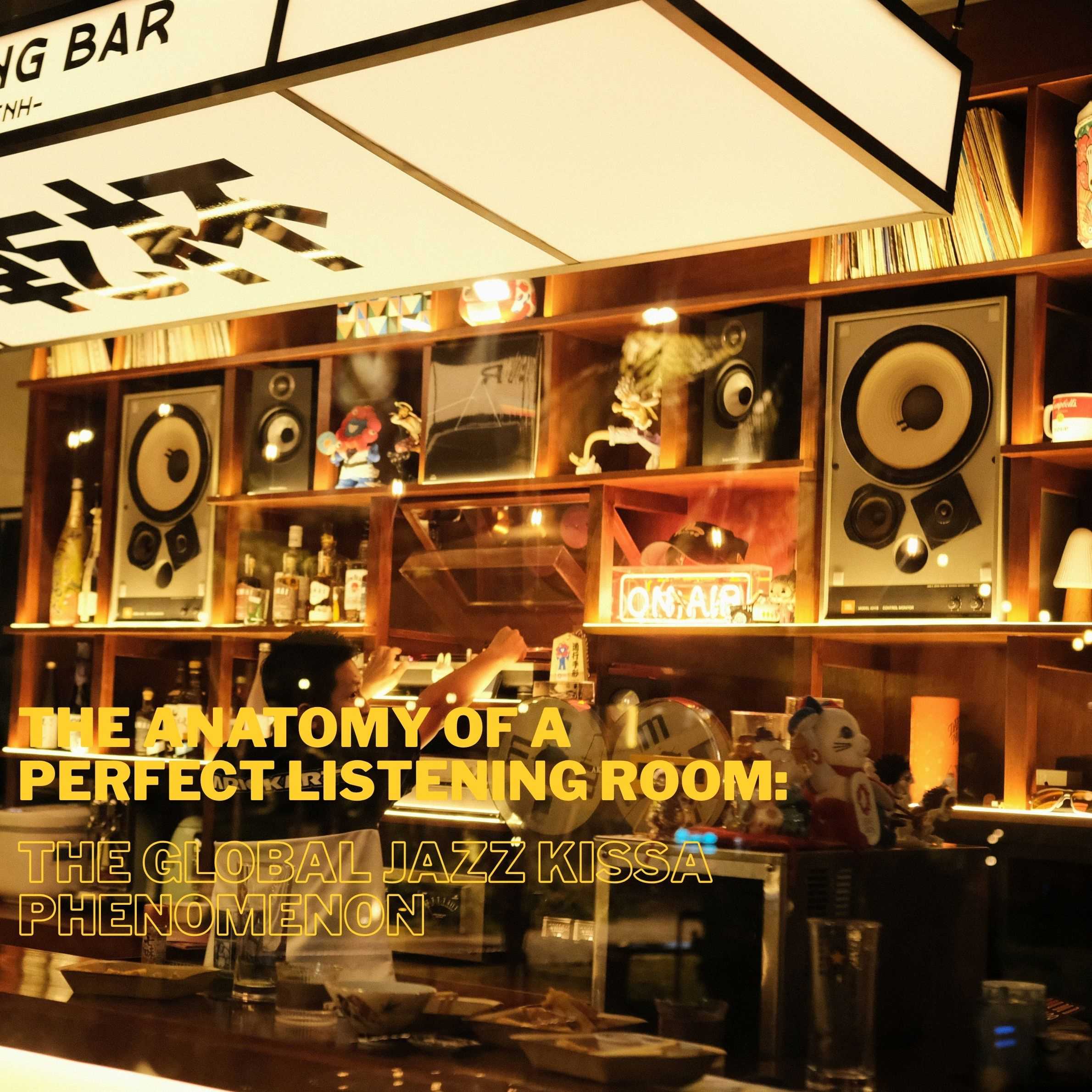
There is a profound difference between hearing music and actively listening to it. In a modern landscape dominated by compressed streaming algorithms, Bluetooth earbuds, and passive background noise, the act of sitting down to do nothing but absorb a record has become a near-revolutionary act. Yet, decades before the West started romanticizing the “vinyl revival,” a subculture in Japan had already perfected the art of high-fidelity sanctuary.
They are called Jazz Kissas (Jazz Cafés)—small, often dimly lit spaces where conversation is discouraged, coffee or whiskey is served in silence, and the only true master of ceremonies is a massive pair of vintage horn speakers spinning pristine jazz pressings. Today, this deeply localized Japanese phenomenon has mutated into a global design and cultural movement, inspiring the sleek audiophile listening bars popping up from London to New York.
But what exactly makes a listening room perfect, and why is the world suddenly craving the quiet gravity of the Jazz Kissa?
The Architecture of Absolute Focus
To understand the birth of the Jazz Kissa, one has to look at post-WWII Japan. In the 1950s and 60s, importing American jazz records and high-end audio equipment was an astronomical financial impossibility for the average citizen. Furthermore, the cramped architecture of Tokyo apartments meant that playing a drum solo at realistic room volumes would instantly alienate your neighbors.
The Jazz Kissa was born out of necessity: it was a communal living room for the obsessed.
Unlike a Western bar where music functions as a social lubricant to keep people talking, a traditional Kissa treats the audio system as a shrine. The seating arrangement is fundamentally linear—staring directly at the speakers as if they were a live orchestra on stage. The acoustic design of these rooms doesn’t chase the sterile, deadened perfection of a modern recording studio. Instead, it embraces the wood-paneled warmth, heavy velvet drapery, and floor-to-ceiling record shelves that act as natural diffusers, creating an intimate, smoky soundstage where the music feels physical.
The Holy Grail Components
A true listening room isn’t about buying the most expensive modern gear; it’s about curation, synergy, and understanding the soul of analog components. The global Kissa diaspora is built on a very specific, almost mythological hardware blueprint:
The Transducers (Speakers): You will rarely find sleek, modern towers here. The Kissa aesthetic is dominated by towering, vintage horn-loaded enclosures—most notably the legendary JBL 43-series studio monitors, Altec Lansing “Voice of the Theatre” systems, or vintage Tannoy dual-concentrics. These speakers are chosen for their effortless dynamic range and their ability to reproduce the physical “crack” of a snare drum and the deep, woody resonance of a double bass at low distortion.
The Amplification: To power these highly sensitive horns, audiophiles rely heavily on the warm, holographic mid-range of vacuum tube (valve) amplifiers or early solid-state Japanese masterpieces from brands like Luxman or Accuphase. It is a sound that prioritizes texture, depth, and edge over clinical sharpness.
The Source: The turntable is the altar. Heavyweight, idler-drive or direct-drive decks like the Garrard 301 or Technics SP-10, fitted with precision tonearms and moving-coil cartridges, ensure that the low-frequency weight of the vinyl is extracted with absolute stability.
“A Jazz Kissa doesn’t ask you to be entertained. It asks you to be present. You aren’t just consuming a commodity; you are sharing a room with the artist’s ghost.”
The Global Migration: Bypassing the Algorithm
As the concept has traveled across the oceans over the last few years, the core philosophy has remained beautifully intact, even as the menus have upgraded from simple pour-overs to artisanal natural wines. Spaces like Spiritland and Brilliant Corners in London, or In Sheep’s Clothing in Los Angeles, have adapted the Kissa blueprint for a new generation of listeners who are visually and sonically fatigued by the digital grid.
This global migration is proof of a collective psychological shift. We don’t need easier access to music; we have every song ever recorded in our pockets. What we need is a framework to actually respect it.
The anatomy of a perfect listening room isn’t found in the decibel level or the price tag of the cables. It is found in the unwritten contract between the room and the listener: the mutual agreement to slow down, drop the needle, and let the pavement outside dissolve into the warm, analog glow of the speakers.